 Add to Chrome
 Add to Firefox
 Add to Edge
ATLAS: Agentic Test-time Learning-to-Allocate Scaling
Jun 01, 2026
Test-time scaling has become a major way to improve large language model reasoning, but its orchestration has remained designer-engineered: a fixed sample budget, a fixed refinement loop, a fixed scoring rule, or a fixed search policy decides how compute is spent, leaving the model in charge of solving but not of orchestration. We introduce ATLAS, an agentic test-time scaling framework in which an LLM orchestrator owns the control loop end-to-end. Through a single action, explore, which dispatches a fresh independent solver on the original problem, the orchestrator decides whether to gather more evidence, when to stop, and how to synthesize the final answer; the action space is extensible, with each explore call optionally specifying solver, reasoning effort, or prompting strategy. We evaluate ATLAS on four benchmarks covering scientific question answering, code generation, and multimodal reasoning under a Claude Sonnet 4.6 backbone, where it reaches 56.00% on HLE-Verified, 82.29% on LiveCodeBench, 85.75% on GPQA-Diamond, and 23.71% on BabyVision while using far fewer API calls than fixed-workflow baselines. A multi-model extension, ATLAS-MM, that exposes solver choice as an additional action dimension further improves HLE-Verified to 60.00% and LiveCodeBench to 85.63%, with consistent gains on GPQA-Diamond and BabyVision. Ablations replacing the orchestrator's direct synthesis with a separate integrator degrade or fail to improve accuracy on three of four benchmarks, consistent with the role of stateful evidence management in producing the gains.

AIBuildAI-2: A Knowledge-Enhanced Agent for Automatically Building AI Models
May 27, 2026AI models underpin data-centric applications from image and text processing to scientific discovery in biology, physics, and chemistry. Yet developing them remains heavily manual, requiring practitioners to design architectures, build training pipelines, and iteratively refine solutions, making it challenging for natural scientists without specialized AI engineering expertise to build the high-performing models their research demands. To reduce this burden and broaden access to AI for scientific discovery, agents that automatically build AI models have been proposed. However, the performance of these agents is largely limited by the parametric knowledge of their underlying large language models, which is static, often outdated, and sparse on practical AI model engineering know-how. To address this limitation, we introduce AIBuildAI-2, a knowledge-enhanced agent with an external, evolving knowledge system for automatically building AI models. The knowledge system of AIBuildAI-2 is hierarchical, organizing curated AI development knowledge into high-level knowledge instructions over topical categories and low-level knowledge documents under each category, from which the agent dynamically loads only the context relevant to its current state and the AI task being solved, grounding each design and implementation decision in concrete, externally verifiable expertise. The system is initialized by collecting and cleaning AI-development-related documents from the web and organizing them into the corresponding categories, and continually evolves from the agent's own experience by distilling each completed run on an AI task into structured takeaways that are written back into the knowledge system. AIBuildAI-2 achieves state-of-the-art results, ranking first on MLE-Bench with a 70.7% medal rate and placing in the top 6.6% among 4,370 human-expert teams in a heart disease prediction competition.
LLMs Know When They Know, but Do Not Act on It: A Metacognitive Harness for Test-time Scaling
May 13, 2026Large language models (LLMs) often expose useful signals of self-monitoring: before solving a problem, they can estimate whether they are likely to succeed, and after solving it, they can judge whether their answer is likely to be correct. However, these signals are typically measured or elicited in isolation, rather than used to control inference. In this work, we ask whether LLMs possess latent metacognitive ability that can be turned into effective test-time control. Inspired by the Nelson--Narens theory from cognitive psychology, we propose a metacognitive harness that separates monitoring from reasoning. For each problem, the model first reports a pre-solve feeling-of-knowing (FOK) signal; after each solve attempt, it reports a post-solve judgment-of-learning (JOL) signal. Rather than treating these signals as passive confidence estimates, the harness turns them into an explicit control interface for reasoning: it decides when to trust the current solution, when to retry with compact metacognitive feedback, and when to pass multiple attempts to a final aggregator. Across text, code, and multimodal reasoning benchmarks, our harness substantially improves a fixed Claude Sonnet-4.6 base model without parameter updates or benchmark-specific fine-tuning. On the evaluated public benchmark snapshots, it raises pooled accuracy from 48.3 to 56.9 and exceeds the strongest listed leaderboard entries on the three primary evaluation settings: HLE-Verified, LiveCodeBench v6, and R-Bench-V. These results suggest that strong LLMs may already possess useful metacognitive ability, but require an explicit control harness to act on it during reasoning.
BioTool: A Comprehensive Tool-Calling Dataset for Enhancing Biomedical Capabilities of Large Language Models
May 07, 2026Despite the success of large language models (LLMs) on general-purpose tasks, their performance in highly specialized domains such as biomedicine remains unsatisfactory. A key limitation is the inability of LLMs to effectively leverage biomedical tools, which clinical experts and biomedical researchers rely on extensively in daily workflows. While recent general-domain tool-calling datasets have substantially improved the capabilities of LLM agents, existing efforts in the biomedical domain largely rely on in-context learning and restrict models to a small set of tools. To address this gap, we introduce BioTool, a comprehensive biomedical tool-calling dataset designed for fine-tuning LLMs. BioTool comprises 34 frequently used tools collected from the NCBI, Ensembl, and UniProt databases, along with 7,040 high-quality, human-verified query-API call pairs spanning variation, genomics, proteomics, evolution, and general biology. Fine-tuning a 4-billion-parameter LLM on BioTool yields substantial improvements in biomedical tool-calling performance, outperforming cutting-edge commercial LLMs such as GPT-5.1. Furthermore, human expert evaluations demonstrate that integrating a BioTool-fine-tuned tool caller significantly improves downstream answer quality compared to the same LLM without tool usage, highlighting the effectiveness of BioTool in enhancing the biomedical capabilities of LLMs. The full dataset and evaluation code are available at https://github.com/gxx27/BioTool
AIBuildAI: An AI Agent for Automatically Building AI Models
Apr 15, 2026AI models underpin modern intelligent systems, driving advances across science, medicine, finance, and technology. Yet developing high-performing AI models remains a labor-intensive process that requires expert practitioners to iteratively design architectures, engineer representations, implement training pipelines and refine approaches through empirical evaluation. Existing AutoML methods partially alleviate this burden but remain limited to narrow aspects such as hyperparameter optimization and model selection within predefined search spaces, leaving the full development lifecycle largely dependent on human expertise. To address this gap, we introduce AIBuildAI, an AI agent that automatically builds AI models from a task description and training data. AIBuildAI adopts a hierarchical agent architecture in which a manager agent coordinates three specialized sub-agents: a designer for modeling strategy, a coder for implementation and debugging, and a tuner for training and performance optimization. Each sub-agent is itself a large language model (LLM) based agent capable of multi-step reasoning and tool use, enabling end-to-end automation of the AI model development process that goes beyond the scope of existing AutoML approaches. We evaluate AIBuildAI on MLE-Bench, a benchmark of realistic Kaggle-style AI development tasks spanning visual, textual, time-series and tabular modalities. AIBuildAI ranks first on MLE-Bench with a medal rate of 63.1%, outperforming all existing baseline methods and matching the capability of highly experienced AI engineers. These results demonstrate that hierarchical agent systems can automate the full AI model development process from task specification to deployable model, suggesting a pathway toward broadly accessible AI development with minimal human intervention.
DAJ: Data-Reweighted LLM Judge for Test-Time Scaling in Code Generation
Jan 29, 2026Test-time scaling for code generation commonly relies on Best-of-N selection, in which multiple candidate solutions are sampled from a base model, and the best one is selected by an LLM judge. However, training reliable LLM judges is challenging due to severe distribution shifts, including imbalances between easy and hard problems, mismatches between training tasks and evaluation benchmarks, and trajectory mismatch arising from training data generated by cheaper models whose behavior differs from that of inference-time models. We propose DAJ, a reasoning-based LLM judge trained with verifiable rewards under a bi-level data-reweighted learning framework. The proposed framework learns data-importance weights (either domain-level or instance-level) to optimize generalization performance on a held-out meta set aligned with target benchmarks. To the best of our knowledge, this is the first application of data reweighting to LLM-as-a-Judge training for test-time scaling. Our approach automatically emphasizes hard problems, in-distribution samples, and trajectory-aligned data, without relying on hand-crafted heuristics. Empirically, DAJ achieves state-of-the-art performance on LiveCodeBench and BigCodeBench, outperforming strong test-time scaling baselines as well as leading proprietary models.
FunPRM: Function-as-Step Process Reward Model with Meta Reward Correction for Code Generation
Jan 29, 2026Code generation is a core application of large language models (LLMs), yet LLMs still frequently fail on complex programming tasks. Given its success in mathematical reasoning, test-time scaling approaches such as Process Reward Model (PRM)-based Best-of-N selection offer a promising way to improve performance. However, existing PRMs remain ineffective for code generation due to the lack of meaningful step decomposition in code and the noise of Monte Carlo-estimated partial-solution correctness scores (rewards). To address these challenges, we propose FunPRM. FunPRM prompts LLMs to encourage modular code generation organized into functions, with functions treated as PRM reasoning steps. Furthermore, FunPRM introduces a novel meta-learning-based reward correction mechanism that leverages clean final-solution rewards obtained via a unit-test-based evaluation system to purify noisy partial-solution rewards. Experiments on LiveCodeBench and BigCodeBench demonstrate that FunPRM consistently outperforms existing test-time scaling methods across five base LLMs, notably achieving state-of-the-art performance on LiveCodeBench when combined with O4-mini. Furthermore, FunPRM produces code that is more readable and reusable for developers.
Models Under SCOPE: Scalable and Controllable Routing via Pre-hoc Reasoning
Jan 29, 2026Model routing chooses which language model to use for each query. By sending easy queries to cheaper models and hard queries to stronger ones, it can significantly reduce inference cost while maintaining high accuracy. However, most existing routers treat this as a fixed choice among a small set of models, which makes them hard to adapt to new models or changing budget constraints. In this paper, we propose SCOPE (Scalable and Controllable Outcome Performance Estimator), a routing framework that goes beyond model selection by predicting their cost and performance. Trained with reinforcement learning, SCOPE makes reasoning-based predictions by retrieving how models behave on similar problems, rather than relying on fixed model names, enabling it to work with new, unseen models. Moreover, by explicitly predicting how accurate and how expensive a model will be, it turns routing into a dynamic decision problem, allowing users to easily control the trade-off between accuracy and cost. Experiments show that SCOPE is more than just a cost-saving tool. It flexibly adapts to user needs: it can boost accuracy by up to 25.7% when performance is the priority, or cut costs by up to 95.1% when efficiency matters most.
DreamPRM-Code: Function-as-Step Process Reward Model with Label Correction for LLM Coding
Dec 17, 2025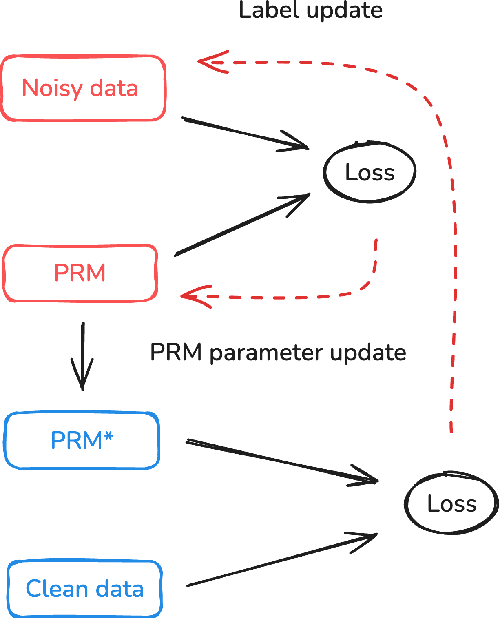
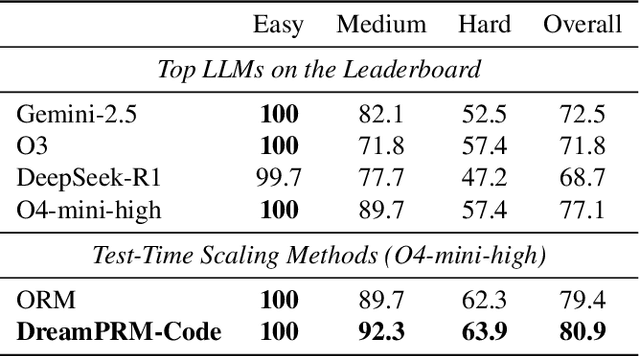
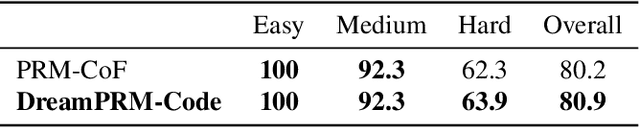
Process Reward Models (PRMs) have become essential for improving Large Language Models (LLMs) via test-time scaling, yet their effectiveness in coding remains limited due to the lack of meaningful step decompositions in code and the noise of Monte-Carlo-generated partial labels. We propose DreamPRM-Code, a coding-focused PRM that treats functions as reasoning steps using a Chain-of-Function prompting strategy to induce modular code generation, enabling PRM training and application analogous to mathematical reasoning tasks. To address label noise, DreamPRM-Code introduces a meta-learning-based correction mechanism that leverages clean final-solution unit-test labels and performs bi-level optimization to refine intermediate labels. Applying on test-time scaling, DreamPRM-Code achieved state-of-the-art performance on LiveCodeBench with 80.9 pass@1 rate, surpassing OpenAI o4-mini.
Neural Operators for Predictor Feedback Control of Nonlinear Delay Systems
Nov 28, 2024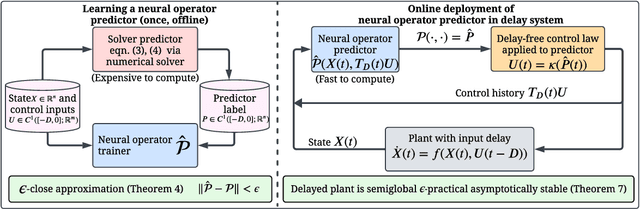

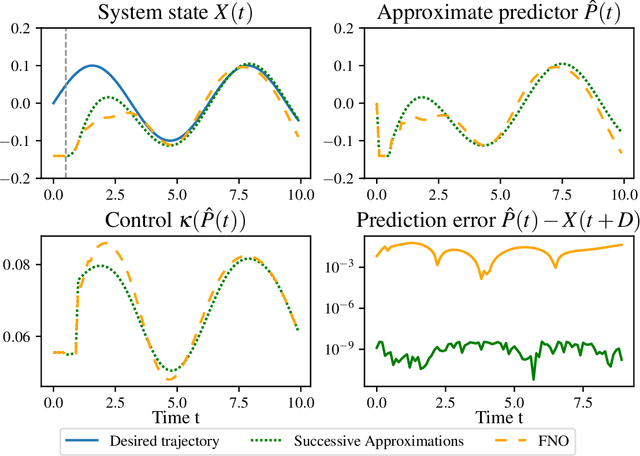

Predictor feedback designs are critical for delay-compensating controllers in nonlinear systems. However, these designs are limited in practical applications as predictors cannot be directly implemented, but require numerical approximation schemes. These numerical schemes, typically combining finite difference and successive approximations, become computationally prohibitive when the dynamics of the system are expensive to compute. To alleviate this issue, we propose approximating the predictor mapping via a neural operator. In particular, we introduce a new perspective on predictor designs by recasting the predictor formulation as an operator learning problem. We then prove the existence of an arbitrarily accurate neural operator approximation of the predictor operator. Under the approximated-predictor, we achieve semiglobal practical stability of the closed-loop nonlinear system. The estimate is semiglobal in a unique sense - namely, one can increase the set of initial states as large as desired but this will naturally increase the difficulty of training a neural operator approximation which appears practically in the stability estimate. Furthermore, we emphasize that our result holds not just for neural operators, but any black-box predictor satisfying a universal approximation error bound. From a computational perspective, the advantage of the neural operator approach is clear as it requires training once, offline and then is deployed with very little computational cost in the feedback controller. We conduct experiments controlling a 5-link robotic manipulator with different state-of-the-art neural operator architectures demonstrating speedups on the magnitude of $10^2$ compared to traditional predictor approximation schemes.